Wednesday, 26 July 2017

Glynhir (Carmarthenshire) 2017

At the end of June (after spending two days in Montgomeryshire) I was able to join the regular recording residential at Glynhir for two days. The first day the whole group visited Talley Lakes, which provided a really good range of sedges, although the lake appeared disappointingly eutrophicated, with bright green algae, most likely due to the presence of excessive numbers of waterfowl. However, there were a few sedges to look at, and Comarum palustre (Marsh cinquefoil) was flowering, which is always a treat.
Carex aquatilis, Carex leporina, Carex vesicaria and Carex rostrata
(Water Sedge, Oval Sedge, Bladder-sedge and Bottle Sedge)

Comarum palustre (Marsh Cinquefoil)
The next day I headed with a small group to an un-recorded tetrad, north of Llandovery, which included somewhat varied habitats, from a small section of the River Towy next to a bridge, to paths and tracks around farmland, including small wooded areas and hedges. I always enjoy the interest of visiting a completely unknown square and although we didn't find anything earth-shattering, we had some interesting finds like this Fumaria muralis (Common Ramping-fumitory).
Fumaria muralis (Common Ramping-fumitory)

Thursday, 6 July 2017

Montgomeryshire Intensive Recording Sessions

The botanical delights of west Montgomeryshire - a short report on Mont Flora Group's intensive recording sessions, 26-28 June 2017 (Guest post - contributed by Gill Foulkes, photos: Polly)

The weather forecast did not look promising; the intense heat of the previous week had abated and the barometer was dropping rapidly but in fact we escaped the anticipated deluge and over-trousers were mostly worn  to prevent a soaking from the wet vegetation.

On Day 1 we met at Cemmaes Road (some came from home, a couple were staying on a local caravan site and others in a local B & B) and split into three groups.  Kate Thorne, Glenys and Aubrey Evans recording locally and were treated to fine views of Cadair Idris as well as a good variety of plants and a bank of sand martins’ nests. The two other groups recorded further down the Dyfi, just to the west of Llanwrin in a secluded, wooded valley.  John Clayfield, Rachel Meade and Peter Foulkes found the Enchanter's Nightshade hybrid C. X intermedia.  Gill Foulkes, John Thorne and Sheila Turner were pleased to find Red Bartsia Odontites vernus in profusion along a farm track. The third group found Lesser Skullcap Scutellaria minor in a good bog.
Gill Foulkes with Dactylorhiza maculata (Heath Spotted Orchid)
The same groups (joined by Polly Spencer-Vellacott, BSBI Welsh Officer) all recorded in the Talbontdrain area on the second day. Intrepid as ever, John Clayfield, Rachel Meade and Peter Foulkes found Parsley fern Cryptogramma crispa and Brittle Bladder-fern Cystopteris fragilis on some old mine buildings. After a steep climb across thistly fields, Polly Spencer-Vellacott, John Thorne, and Gill Foulkes were rewarded with a small boggy area (someone's private nature reserve by the look of it) with a very large colony of Heath Spotted orchids Dactylorhiza maculata.  The third group found another good bog. 
Acaena novae-zelandiae (Pirri-pirri bur) - possibly a relatively new invasive in the area?
Two different groups in two different monads found Pirri-pirri bur Acaena novae-zelandiae; the second reported record for Montgomeryshire (the Montgomeryshire Field Society found it earlier this year near the Centre for Alterntaive Technology).  This plant can become especially invasive when it establishes in the wild.  Perhaps it should be listed on Schedule 9 of the Wildlife and Countryside Act in England and Wales before it's too late???
The dramatic landscape of Pistill-y-llyn
 On the final day, the group recorded at Pistyll-y-llyn where the Afon Llyfnant marks the border between VC46 (Cardiganshire) and VC47 (Montgomeryshire).  Mark Lawley (county recorder for bryophytes) and his friend Ralph Martin joined us and recorded 105 bryophytes (24 liverworts and 81 mosses). However, it was Ralph who spotted Brittle Bladder-fern Cystopteris fragilis in an old mine wheel pit.  
Cystopteris fragilis (Brittle Bladder-fern)
Five colonies of Wilson's filmy fern Hymenophyllum wilsonii were found (and there were undoubtedly more) by John Clayfield in his relentless search amongst large boulders.  We had hoped to refind Mountain Male- fern Dryopteris oreades, but although a specimen was taken this has not been confirmed.  A steep, gravelly Calluna slope provided great habitat for a delightful small eyebright (possibly Euphrasia micrantha but still to be verified).  At the very end of the day and within sight of the cars, Kate Thorne found more hybrid Enchanter's nightshade C. X intermedia.

In total the three days produced over 1300 records and participants were introduced to the delights of west Montgomeryshire.  It is appropriate that the county flower, the delicate Ivy-leaved bellflower Wahlenbergia hederacea, was found in most monads visited. 
Wahlenbergia hederacea (Ivy-leaved Bellflower) 

Wednesday, 14 June 2017

BSBI Welsh AGM and ASM - part II

Last Wednesday evening at the Stamford Gate we were treated to a talk about Flintshire from the Emeritus Recorder, Dr Goronwy Wynne.
Dr Goronwy Wynne, the BSBI's
Emeritus Recorder for Flintshire
Goronwy has lived most of his life in Flintshire, and was recorder for over 40 years from 1963 to 2009. He spoke of the geology of the county and the altitude, and also talked of the way geology affects the vegetation on every scale from large to small. He also described some of the botanists that have worked in Flintshire, including anecdotes about Thomas Pennant. He finished off by telling us a few of the most common and rarest species in Flintshire. Goronwy was a colleague of my grandfather, who also contributed records to him for the Flora of Flintshire. He spoke without any PowerPoint or slides, but managed to hold the meeting's attention completely. 

On Thursday I joined the BSBI President John Faulkner, and Gillian Faulkner, and Oxfordshire VCR David Morris (see David's blog). We were allocated a square and delighted to find Maes Hiraddug SSSI (a Wildlife Trust Reserve). This grassland was lovely to see with many orchids: Dactylorhiza fuchsii (Common Spotted Orchid) and Neottia ovata (Common Twayblade). Then, as a special treat, we found a few fronds of Ophioglossum vulgatum (Adder's-tongue) and then a few more. 
Ophioglossum vulgatum (Adder's-tongue)
Having explored these meadows thoroughly we went on up a cycle track, into an old quarry, and down some lanes finding Fumaria capreolata (White Ramping-fumitory) in a hedge, we then eventually found access onto Moel Hiraddug, a limestone outcrop where we saw Helianthemum oelandicum (Hoary Rock-rose) over large areas near the summit. By this time the weather was threatening again, although we only had a few showers, and I failed to take any more photographs. 

I was unable to go out botanising on the final Friday, but it was wonderful to see so many botanists enjoying Flintshire, and to spend a few days in the field in good botanical company. I know Flintshire will be grateful for the extra records, which must be several thousands! 
David Morris and John Faulkner with Adder's-tongue

Friday, 9 June 2017

BSBI Welsh AGM and ASM - part I

This week has been a busy week although I for one did not have to stay away from home in order to join the BSBI Welsh AGM and Annual Summer Meeting, as both events (rolled into one) took place in Flintshire this year.

Monday afternoon was wet and I had no childcare available so I remained at the Stamford Gate hotel to meet new arrivals, watch Jonathan Shanklin's fascinating talk and then even with my young proto-botanists in tow joined Lynne Farrell for dinner.
The most junior attendees!
Tuesday was notable for gale-force winds, but we boarded a coach and spread the day between Gronant Dunes and Graig Fawr. There was very little rain but the wind made reaching the summit a struggle. However, after making our way over the summit where non-flowering plants of Veronica spicata (Spiked Speedwell) were spotted by the most intrepid, we returned along the bottom of the crag, where various special plants including Silene nutans (Nottingham Catchfly) were easily seen.
Photographing Geranium sanguinum (Bloody Cranesbill)
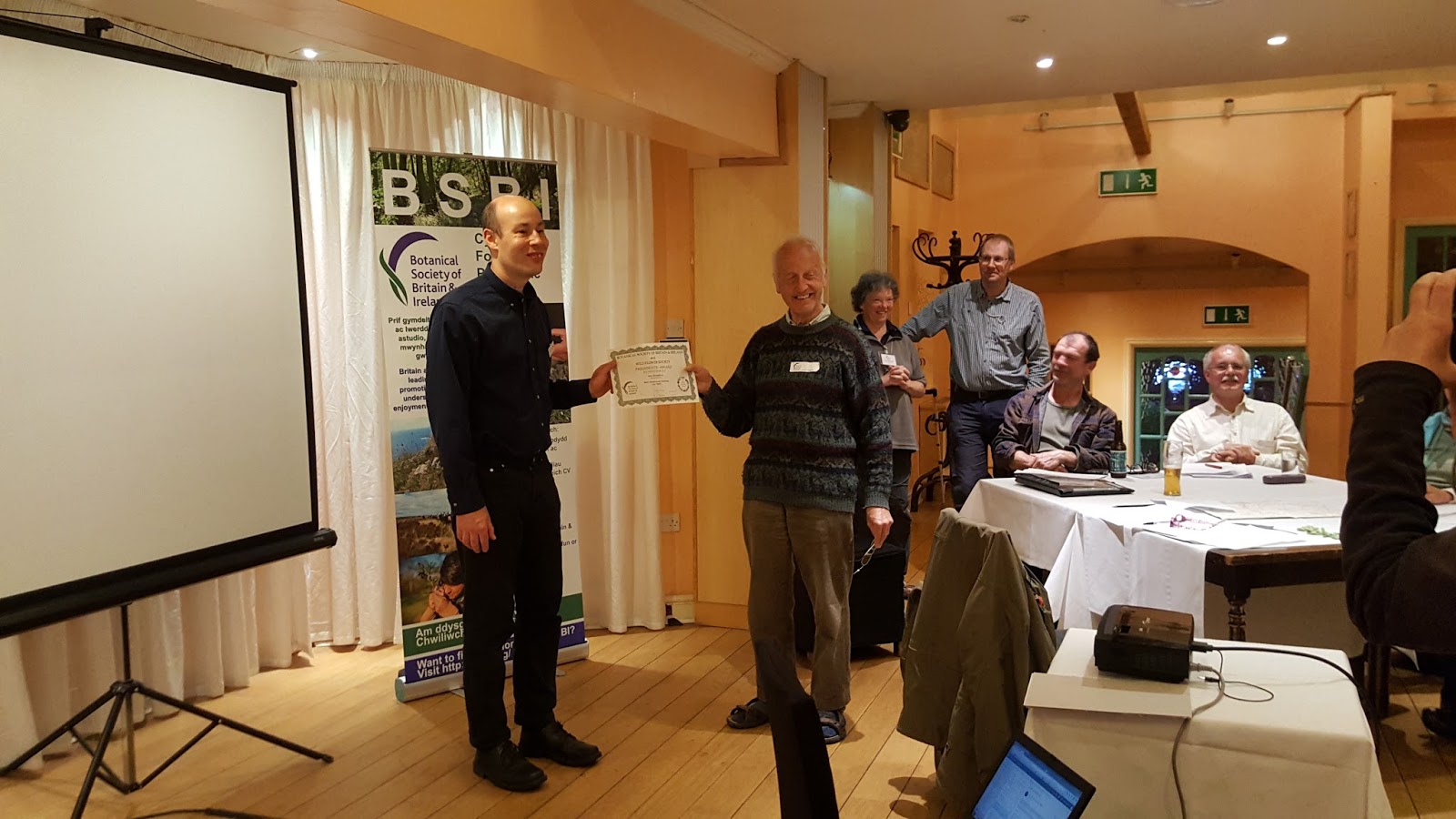
Tuesday evening was occupied by the Committee for Wales meeting (before dinner) and the Welsh AGM (after dinner). However, a most pleasurable moment was provided by John Faulkner presenting the Presidents' Award to Tom Humphrey for his work in developing and maintaining the BSBI's Distribution Database. This was warmly applauded by the audience which included many vice-county recorders who have benefited from this powerful and informative database.
Tom Humphrey being presented with the Presidents' Award by John Faulkner
On Wednesday I joined Laura and Graham to record a tetrad along the coast near Mostyn, where we spent a significant amount of time keying out various species (and improving our knowledge) while adding to the species list. There were 136 taxa listed for the square since 2000; hopefully (subject to analysis) we will have improved this significantly. It was a lovely sunny day although still windy enough to keep our coats on.
Keying out a tricky specimen with Graham - photo Laura Gravestock

Wednesday, 19 April 2017

Rare Plant Register coverage update

For anyone who was hoping to watch the item on Heno (S4C), it was actually shown a day later than I was originally told. An iPlayer link is here. A transcript (with translation at your own risk - apologies for any errors) is available here.

Friday, 7 April 2017

More Rare Plant Registers/ Rhestrau Planhigion Prin

It's been great to see the response to the Rare Plant Register launch.

Following the event in Aberystwyth and the interview with Good Evening Wales, I went to the BBC's Wrexham studio to record an interview with Rachel Garside for Country Focus - the link is available here (until 3rd May 2017, you can start about 7 minutes), and a transcript can now be seen here.

This week I met Gerallt Pennant at Loggerheads Country Park, to show him the Rare Plant Registers (also to be known as Rhestrau Planhigion Prin).  After some discussion I recorded a few soundbites (in Welsh) to be included in an item on Heno on S4C. We expect it to be broadcast on Tuesday 11th April 2017 at 1900, and after that it should be available on iPlayer. English subtitles are available for those who need them.

You can read more about it over on the BSBI News and Views blog.
Rare Plant Registers for 13 counties of Wales

Monday, 27 March 2017

A Welsh first - the launch of the Rare Plant Registers

Today in Aberystwyth we celebrated a tremendous Welsh achievement. This year we have completed the series of Rare Plant Registers, making Wales the first country to have a Register for each county, showing the locations for all the rare plants.

The project was begun in 1978 following a request from Glyn Jones of the Nature Conservancy Council to Arthur Chater, for a list of the Rare Plants in Cardiganshire. Arthur gave the matter serious thought, and after significant discussions, produced the first Rare Plant Register in spring 1979 (for me, the year of my birth). In the next 20 years, while I was growing up, rare plant registers were published in Carmarthenshire and Radnorshire. Then in 2005 the Committee for Wales met and decided these documents were so worthwhile that they should work towards a Register for all the counties in Wales. In 2005-2009 a further five Registers were produced. In 2011 I was appointed as the BSBI's first Welsh Officer, and was able to support three (fairly newly appointed) vice-county recorders to produce Registers in 2014. Finally, this year in 2017 we have managed to produce Registers for the missing counties, making a complete set.

Map of Wales showing the vice-counties with the year in which their Rare Plant Register was first published.
This achievement makes us the first county in the world to be able to list the locations for all of our rare plants - there are some other Rare Plant Registers in England, Scotland and Wales, but we are not aware of more beyond Britain and Ireland. The Rare Plant Registers provide a very important resource for those working in conservation.

Today in Aberystwyth we had a welcome from Emyr Roberts, the chief executive of Natural Resources Wales, who talked of the achievement and how Wales can punch above it's weight!
Emyr Roberts
Then Kevin Walker, the BSBI's Head of Science, talked about the value of the BSBI's data collection to conservation - from Atlas recording to the Rare Plant Registers but also the Threatened Plant Project.

Kevin Walker
Later Andy Jones and I shared a platform and a talk on the Welsh Rare Plant Registers as a Domesday Book of plants.
Polly Spencer-Vellacott (me) and Andy Jones
As if the day hadn't been busy enough, I finished off with a live (if short) interview on BBC Radio Wales. If you want to hear it you can follow this link and start about 1:54 to hear me.

I would like to congratulate all the vice-county recorders of Wales who have dedicated so much work to recording the flora and to producing the Rare Plant Registers. It really has been a labour of love for them.