 |
| Anacamptis morio - Green-winged orchid |

BSBI Cymru - from Barbara Brown, Welsh Officer
Wednesday, 18 May 2016
More North Wales Limestone
Still in North Wales on the limestone outcrops, here is the green-winged orchid. The only previous detailed record I had seen said 16 spikes, but last week I found around 70, and a few more just into the next 10km square. This is a great time of year to visit your local populations and check on them - a count is useful.

Thursday, 12 May 2016
A day on the Orme
I had the joy of spending a day on the Great Orme with Wendy McCarthy, the county recorder (and others) yesterday. Wendy lives on the Orme so her knowledge is unrivalled. We began with a visit to the sole remaining plant of Antennaria dioica - mountain everlasting. Another population on the Orme seems to have disappeared - after grazing was reduced the sward is so much longer and thicker. Could Antennaria still be present but invisible? We would hope so, but the reintroduction of sheep grazing is an urgent need.
 |
| Antennaria dioica - mountain everlasting |
 |
| Hieracium cambricum - Welsh hawkweed |
 |
| Helanthemum oelandicum - hoary rockrose |
 |
| Hippocrepis comosa - horseshoe vetch |
 |
| Scilla verna - spring squill |
Friday, 22 April 2016
Spring is finally here!
Up in the woods in Denbighshire this week, leaves are beginning to appear. Only just out, can you recognise these? I'm not sure I would if I didn't know the spot and wasn't looking for it specifically (scroll down for a more unfurled picture)!
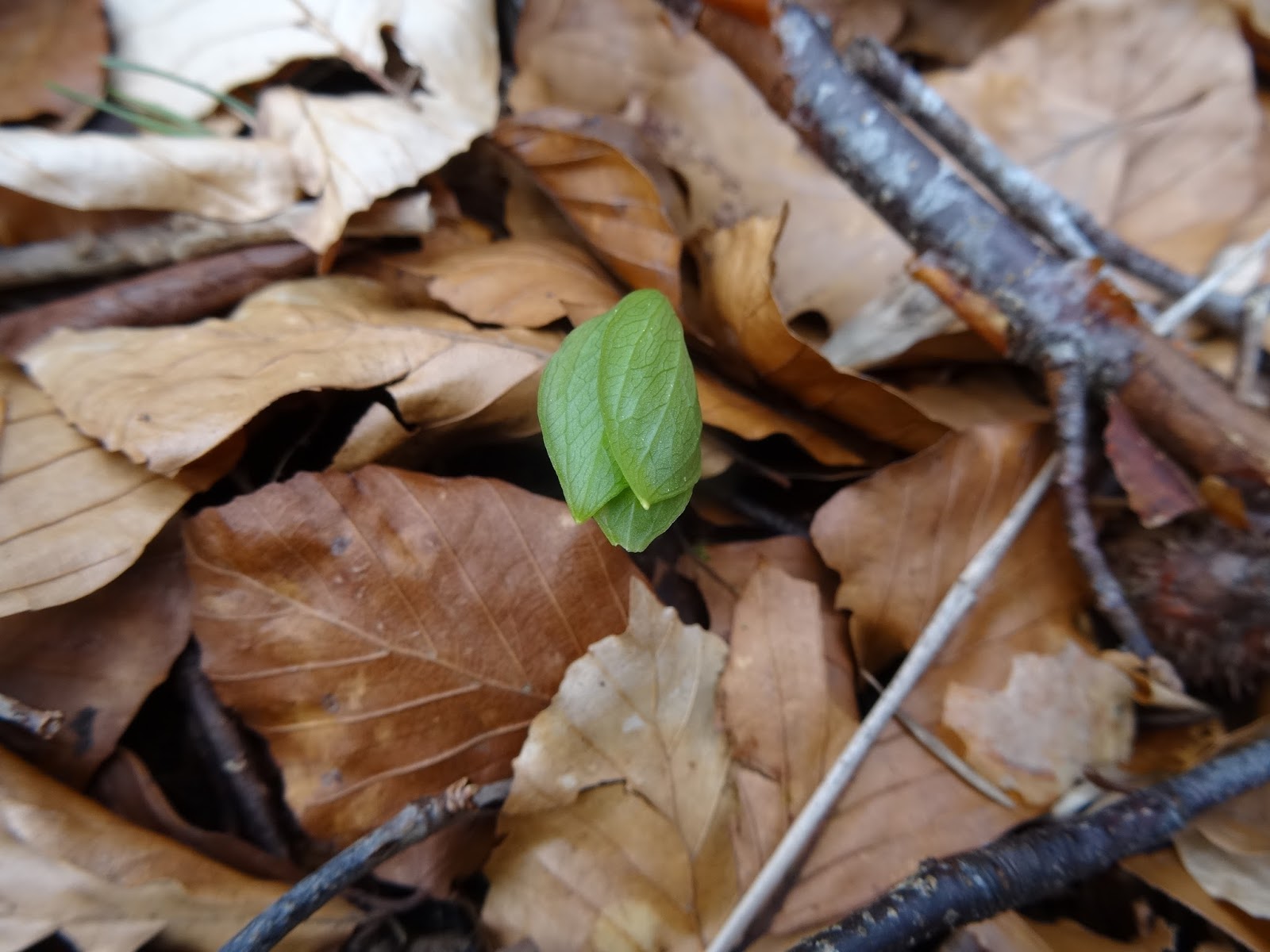
I love this time of year when the woodland spring flowers really are coming out. Bluebells are now beginning to open in their masses, the verges of the A55 are yellow with cowslips, the primroses are everywhere and I do love wood anemones.
 |
| Wood anemone - Anemone nemorosa |
And that seedling I saw at the top of the page? Scroll down if you want to see - one of our really distinctive and certainly not a common plant...
 |
| Herb Paris - Paris quadrifolia |
Wednesday, 16 March 2016
Bright eyes at Treborth...
On Saturday I was amongst a group of botanists - apparently one of us was the 100th to participate in Chris Metherell's introduction to Eyebrights (Euphrasia).
With no prior knowledge of the genus, I was a little nervous about the course, but I was delighted to find the day whizzed past.
Chris gave us an introduction, which largely explained how to look at eyebrights - and there really is a great deal of detail. I have a much clearer idea of the distinction between upper cauline leaves and lower floral leaves, but I think I still need practice in looking at the tips of leaf teeth to discriminate between acute, acuminate and aristate! However, the new keys that Chris has produced take you through which are the most important features.
After the introduction we spent the middle part of the day (with a break for lunch) looking at various herbarium specimens - some fairly old and brown from the Bangor University herbarium, and some still relatively green from Chris' own herbarium.

I began to really look forward to summer, when I hope to test my new-found skills in the field - and I hope that many of the characters will be much easier to determine on fresh specimens.

We were lucky enough to be using the teaching lab at Treborth Botanic Garden, a place familiar to Bangor alumni and locals. And this course was very much aimed at locals, with most of the participants coming from North Wales (a few from North West England). Chris focussed on the species we would be likely to encounter in Wales.
A big thank-you to Chris - who left us all full of enthusiasm - and we hope to practice our skills in the field before long. I for one am also looking forward very much to the publication of the new Euphrasia handbook, hopefully within the next year.
With no prior knowledge of the genus, I was a little nervous about the course, but I was delighted to find the day whizzed past.
Chris gave us an introduction, which largely explained how to look at eyebrights - and there really is a great deal of detail. I have a much clearer idea of the distinction between upper cauline leaves and lower floral leaves, but I think I still need practice in looking at the tips of leaf teeth to discriminate between acute, acuminate and aristate! However, the new keys that Chris has produced take you through which are the most important features.
After the introduction we spent the middle part of the day (with a break for lunch) looking at various herbarium specimens - some fairly old and brown from the Bangor University herbarium, and some still relatively green from Chris' own herbarium.

I began to really look forward to summer, when I hope to test my new-found skills in the field - and I hope that many of the characters will be much easier to determine on fresh specimens.

We were lucky enough to be using the teaching lab at Treborth Botanic Garden, a place familiar to Bangor alumni and locals. And this course was very much aimed at locals, with most of the participants coming from North Wales (a few from North West England). Chris focussed on the species we would be likely to encounter in Wales.
A big thank-you to Chris - who left us all full of enthusiasm - and we hope to practice our skills in the field before long. I for one am also looking forward very much to the publication of the new Euphrasia handbook, hopefully within the next year.
Thursday, 18 February 2016
Field meetings 2016
It's been a few weeks now since the Yearbook arrived on my doorstep, and there are a great selection of field meetings for this year. For me it is now a matter of juggling my calendar with my family to decide how many I can manage to get to.
My first priority will be the Welsh AGM (12th-15th July), which is always a great event. This year it's down in Brecon, and there is a great offer for accommodation, with a single price £160 for a room for up to four nights - a great price if you can stay all week and even better if you can share a room. There will be some great excursions - chances to explore the Brecon Beacons or the canal and Wye, and some special sites including Stanner Rocks and Vicarage Meadows. For more details click here.
I'm organising a couple of training meetings in Wales - there may still be one or two places on the beginners' Euphrasia workshop on 12th March (and more places on 13th if there are any improvers out there?). However, the Drypoteris course in October (1st-2nd) is now fully booked - although I will add names to a waiting list if desired. There is also a grass training weekend in Glamorgan with the excellent Arthur Copping (25th-26th June) which I suspect will provide more than the advertised introduction, and a brambles weekend at the end of July (29th-31st) in Denbighshire which should be very interesting.
The recording weeks in Merionethshire (22-25 July) and Carmarthenshire (4th-11th July) are always very enjoyable - and for me, a great chance to keep my field skills polished up.
Hopefully I will see plenty of you at some of these meetings - but do send the organisers an email if you are interested and haven't done so yet!
My first priority will be the Welsh AGM (12th-15th July), which is always a great event. This year it's down in Brecon, and there is a great offer for accommodation, with a single price £160 for a room for up to four nights - a great price if you can stay all week and even better if you can share a room. There will be some great excursions - chances to explore the Brecon Beacons or the canal and Wye, and some special sites including Stanner Rocks and Vicarage Meadows. For more details click here.
I'm organising a couple of training meetings in Wales - there may still be one or two places on the beginners' Euphrasia workshop on 12th March (and more places on 13th if there are any improvers out there?). However, the Drypoteris course in October (1st-2nd) is now fully booked - although I will add names to a waiting list if desired. There is also a grass training weekend in Glamorgan with the excellent Arthur Copping (25th-26th June) which I suspect will provide more than the advertised introduction, and a brambles weekend at the end of July (29th-31st) in Denbighshire which should be very interesting.
The recording weeks in Merionethshire (22-25 July) and Carmarthenshire (4th-11th July) are always very enjoyable - and for me, a great chance to keep my field skills polished up.
Hopefully I will see plenty of you at some of these meetings - but do send the organisers an email if you are interested and haven't done so yet!
Sunday, 3 January 2016
New Year Plant Hunt 2016
Despite a much less than pleasant weather forecast, I met Georgina and Martyn at Acton Park in Wrexham to begin our attempt at the New Year Plant Hunt.
 |
Plant Hunt Selfie!
|
The rain stayed away for a few hours; we found a number of plants around the edges of the park and the surrounding area. Can anyone help identify this garden marigold wandering into Acton Park?

After a lunch break we decided to move on a bit to the Wrexham Industrial estate, which did indeed provide more variety; including four species of Vicia (tetrasperma, cracca, hirsuta and sativa; also Medicago lupulina and arabica) and also Euronymus europaeus. By the end we had totted up 57 species, not a record for Wales but satisfying nevertheless. The top family was unsurprisingly Asteraceae with 14 species; second place more surprisingly was Fabaceae with 7 and third was Brassicaceae with 6. We also found four grasses open and flowering (Poa annua, Arrhenatherum elatius, Dactylis glomerata and Lolium perenne). My photos are not up to much but here is a selection as a collage...


For more information or to take part in your own New Year Plant Hunt (up to the 4th Jan) see BSBI News and Views.
Other Welsh hunts have been Tim Rich with 59 species in Cardiff; John Warren with 27 in Aberystwyth, and a whopping 67 in the Chepstow area from the Monmouthshire Botany Group.
Friday, 1 January 2016
New Year Plant Hunt
Happy New Year! Would anyone local-ish like to join me tomorrow on Saturday 2nd January at Acton Park in Wrexham for a New Year Plant Hunt? The aim is to find as many plants in flower as possible in three hours, although we could also do some general recording.
Meet at 11 am at SJ345 518. Let me know if you plan to come (if the weather is appalling we'll cancel or possibly postpone to the Sunday. I'm prepared to go in moderate weather but not driving snow or rain! Warm clothes and thermoses?
If you're not local why not have your own hunt? For more information see the BSBI publicity blog
http://bsbipublicity.blogspot.co.uk/2015/12/bsbi-new-year-plant-hunt-2016-how-to.html
Meet at 11 am at SJ345 518. Let me know if you plan to come (if the weather is appalling we'll cancel or possibly postpone to the Sunday. I'm prepared to go in moderate weather but not driving snow or rain! Warm clothes and thermoses?
If you're not local why not have your own hunt? For more information see the BSBI publicity blog
http://bsbipublicity.blogspot.co.uk/2015/12/bsbi-new-year-plant-hunt-2016-how-to.html
Subscribe to:
Posts (Atom)